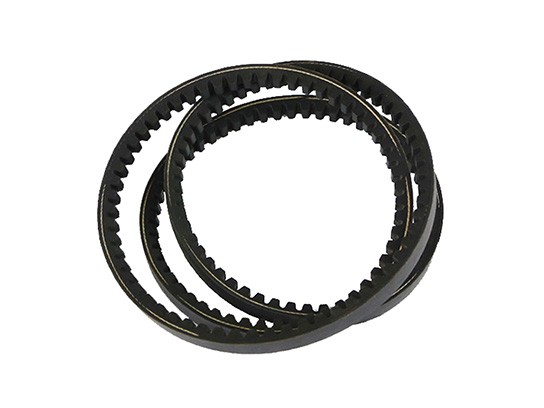
Available Types: AV10, AV13, AV17, AV22
Standard: ISO 4184 / BS 3790
Available Grades: Normal
Other Names: Raw Edge V-belt
SHENWEI Raw Edge V-Belt is specially designed for automotive drives.
Section Size of Raw Edge V Belts for Automobile
| Section | Top Width(mm) | Thickness(mm) | Angle(Degree) |
| AV10/ZX | 10.0 | 6.0 | 40 |
| AV13/AX | 13.0 | 8.0 | 40 |
| AV17/BX | 17.0 | 11.0 | 40 |
| AV22/CX | 22.0 | 14.0 | 40 |
Section Size of lndustrial Raw Edge V Belts
| Section | Top Width(mm) | Thickness(mm) | Angle(Degree) |
| ZX | 10.0 | 6.0 | 40 |
| AX | 13.0 | 8.0 | 40 |
| BX | 17.0 | 11.0 | 40 |
| CX | 22.0 | 14.0 | 40 |
| DX | 32.0 | 19.0 | 40 |
Section Size of Narrow Raw Edge Belts
| Section | Top Width(mm) | Thickness(mm) | Angle(Degree) |
| XPZ | 10.0 | 8.0 | 40 |
| XPA | 13.0 | 10.0 | 40 |
| XPB | 17.0 | 14.0 | 40 |
| XPC | 22.0 | 18.0 | 40 |
| 3VX | 9.7 | 8.0 | 40 |
| 5VX | 15.8 | 14.0 | 40 |
| 8VX | 25.4 | 23.0 | 40 |
What is a Raw Edge V Belt?
fabric wrapping on the outside of the belt, leaving the interior materials exposed on the sides. The belt, provided with a higher coefficient of friction, can now better grip the sheaves. This increased grip means that the raw-edged belt transmits more horsepower at higher speeds, as much as a 30% increase in some cases.
Increased power is a substantial benefit of this type of belt. There are several other benefits worth mentioning, as well. Raw-edge belts, because of the inclusion of the cogs, are better able to wrap around smaller sheaves. These belts also run cooler at higher speeds and generally have better temperature resistance.
Features
- Large intensity, high flexibility, good durability
- Special Bottom rubber used, small elongation and long service life
- Excellent heat-resistance, oil-proof, and wearing resistance
- High transmission efficiency
- Suitable for band pulley with minor diameter
- Safe performance can be guaranteed even during high-speed operation
Are Cogged Belts Better Than V-Belts?
In industry and commerce, about one third of electric motors use belt drives. Belt drives provide flexibility in positioning the motor relative to the load. Pulleys of different diameters (pulleys) allow the speed of the driven device to be increased or decreased. A properly designed belt drive system is efficient, low noise, does not require lubrication, and has low maintenance requirements. However, some types of belts are more efficient than others, offering potential energy cost savings.
Most belt drives use a V-belt. The V-belt uses a trapezoidal cross section to create a wedge action on the pulley to increase friction and the belt’s power transmission capacity. Connections or multiple belts are designated for heavy loads. The V-belt drive can achieve a peak efficiency of 95% to 98% when installed. Efficiency also depends on pulley size, driving torque, under belt or over belt, and V-belt design and construction. If a slip occurs because the belt is not regularly re-tensioning, the efficiency is reduced by 5% over time (nominal efficiency is 93%).
The Cogged belts has grooves perpendicular to the length of the belt. These grooves reduce belt bending resistance. Cogged belts can be used with the same rated V-belt or with the same pulley. They run colder, last longer, and are about 2 percent more efficient than the standard V-belt.
Synchronous belts (also known as timing belts, forward drive belts, or high torque drive belts) are toothed and require the installation of a matching toothed drive sprocket. The Synchronous belts is about 98 percent efficient and maintains this efficiency over a wide load range. In contrast, V-belt efficiency decreases sharply at high torque due to increased slip. The timing belt requires less maintenance and re-tensioning, operates in wet and greasy environments, and has no slippage. However, the synchronous belt is noisy, unsuitable for shock loads, and can transmit vibration.
INQUIRY
Please Feel free to give your inquiry in the form below. We will reply you in 24 hours!